
By Chef Samantha Tilley, executive chef at The Market CT and former chef-owner of Mockingbird Kitchen & Bar.
Peking duck, Běijīng kǎoyā (北京烤鸭), traces its roots to the imperial kitchens of China. Roast duck was a court dish under the Ming dynasty, and when the capital moved north to Beijing in the early 1400s, the dish came with it. Two great restaurant traditions grew up around it: Bianyifang, founded in the Ming era, roasted ducks in a closed oven, and Quanjude, founded in 1864, hung them over an open fruitwood fire. Both still serve the city today. For centuries it has been Beijing's banquet dish, carved at the table and eaten wrapped in thin pancakes.
Peking duck isn't a roast duck recipe. It's a method built on air, heat and time, and the goal is skin so crisp it shatters. Most of the work happens before the bird ever sees the oven: the skin is scalded to tighten it, glazed, and dried for hours. Flavor is kept restrained so texture can lead. Home cooks can't recreate a hanging wood-fired oven, but they can follow the same principles, and the results are worth the two days.
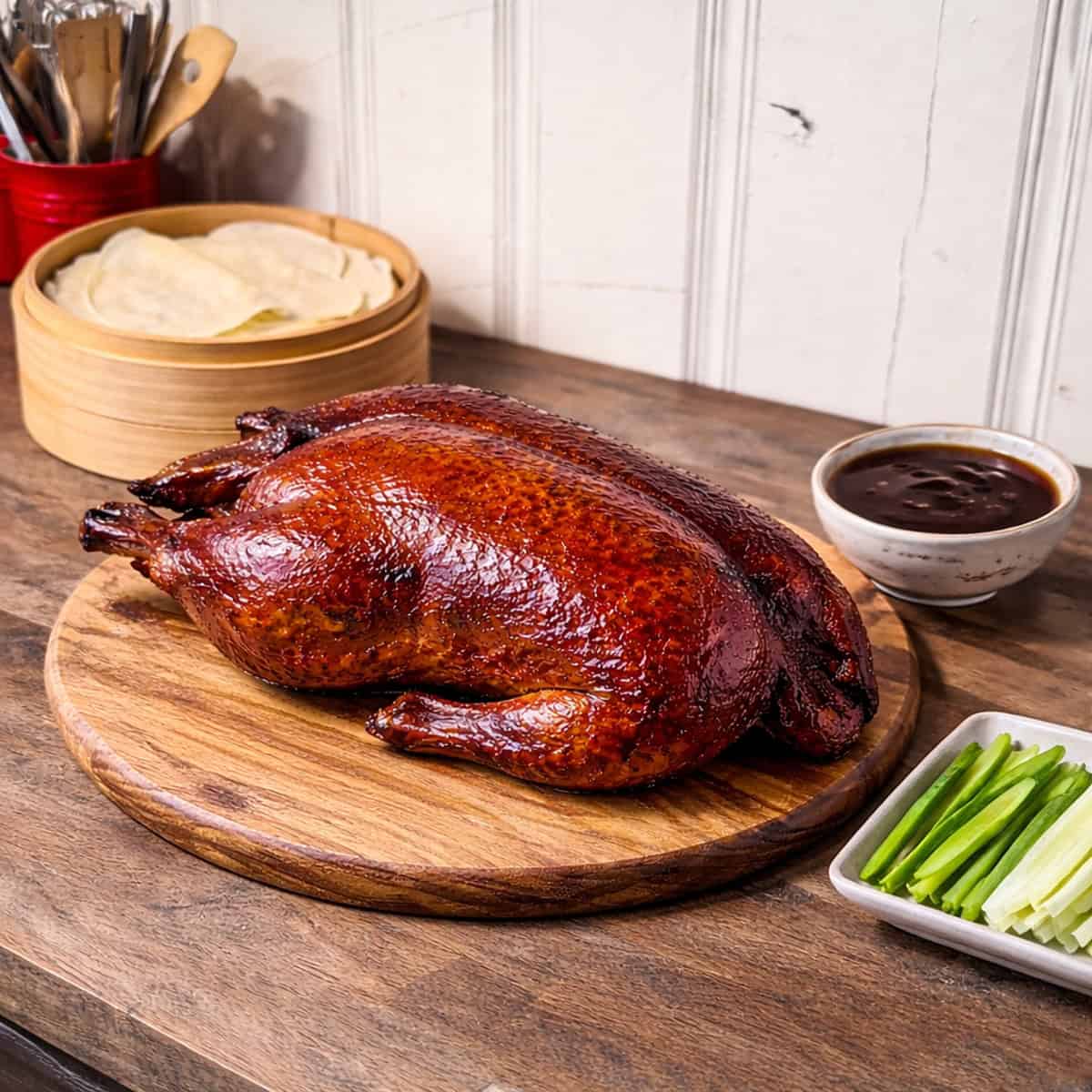
The first thing you notice is the sound. The skin cracks when it's cut, glossy and mahogany. Lay a piece on a warm pancake with a swipe of sweet bean sauce, a few strips of scallion and cucumber, roll it up and take a bite: crisp, soft, rich, fresh. It's a dish to eat slowly, one bite at a time.
Technique Intelligence
Why it takes two days
On day one, the skin is tightened with boiling water, glazed and dried. On day two, the dry skin goes into high heat so the fat renders away and the surface turns brittle and light. Treat the skin as its own component and give it time.
Scald the skin
Pouring boiling water over the duck tightens the skin instantly and shrinks it away from the fat underneath. This is the step shortcuts skip, and the one that makes proper drying and rendering possible.
Dry it completely
Moisture is the enemy of crisp skin. Dry the glazed duck uncovered in the refrigerator, ideally on a rack, or hang it in front of a fan in a cool room. When the skin feels dry and papery to the touch, it's ready.
Render, then crisp
Roast on a rack over a pan so the fat drips away from the bird. Start at 425°F to set and color the skin, then lower to 350°F so the fat renders slowly while the skin crisps. Watch closely, especially with a honey glaze, which browns quickly; tent loosely with foil if it darkens too fast. The duck is done at 165°F in the thickest part of the thigh.
What goes wrong
Wet skin steams. Skin that isn't rendered softens. Rushed drying blisters instead of shattering. And if the glazed duck tastes sweet, the balance slipped: the glaze is for color and texture, not sugar.
Ingredient Intelligence
Duck(鸭子)
A whole duck with intact, unbroken skin is essential. Pekin (Long Island) duck is the classic American choice; Maple Leaf Farms is widely available, frozen or fresh. Duck is fatty by nature, and that fat is an asset if it renders away from the skin. Save it for roasting potatoes.
Maltose or Honey Glaze(麦芽糖 / 蜂蜜)
The glaze is for sheen and structure. Maltose, sold in jars at Asian markets, dries hard and clear and gives the lacquered finish. Honey works at home but browns faster, so watch it.
Vinegar(醋)
Added to the glaze to tighten the skin and cut the fat. You should never taste it.
Aromatics(香料)
Ginger, scallions and sometimes star anise, tucked loosely in the cavity, perfume the meat without touching the skin. Don't overstuff; air still needs to move.
Pancakes and Sauce
Mandarin pancakes (薄饼), thin and soft, are sold frozen at Asian markets; steam them to warm. Sweet bean sauce (甜面酱) is traditional in Beijing; hoisin is the familiar substitute. Lee Kum Kee makes both.
Variations
- Duck breast shortcut: Score skin-on duck breasts, dry them uncovered overnight, then render skin-side down in a cold skillet and finish in the oven. Slice and serve the same way.
- Bao instead of pancakes: Serve in steamed lotus-leaf buns.
- Five-spice: Rub a little five-spice powder and salt inside the cavity before drying.
- Lettuce cups: Wrap the duck in butter lettuce for a lighter version.
Make Ahead, Storage and Freezing
Make ahead: The scalding, glazing and drying are done a day ahead by design. Cut the scallions and cucumber a few hours ahead and keep them chilled and covered.
Storage: Refrigerate leftover duck up to 3 days.
Freezing: Freeze leftover meat up to 2 months; the skin won't stay crisp.
Reheating: Reheat skin-side up on a rack at 400°F for 8 to 10 minutes. Use the carcass for stock or soup and the meat for stir-fries or fried rice; nothing goes to waste.
What to Serve with Peking Duck
- Mandarin pancakes, sweet bean sauce or hoisin, and thin-cut scallions and cucumber
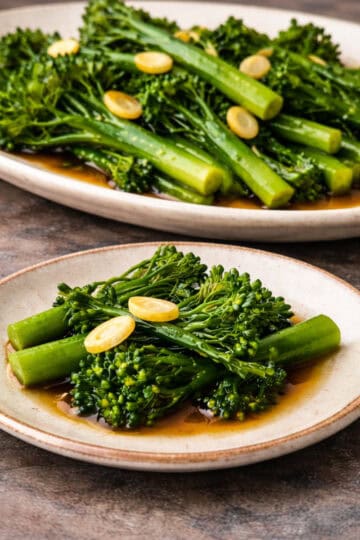
- Chinese Greens with Garlic
- Steamed Whole Fish and Long Life Noodles for a banquet
- A Brut sparkling wine to cut the fat, a light, low-oak Pinot Noir, or a dry to off-dry Riesling. Avoid heavily tannic or oaky reds.
Peking Duck FAQ
What's the difference between Peking duck and roast duck? Roast duck celebrates the meat. Peking duck celebrates the skin, which is scalded, glazed and dried before roasting.
Can I skip the boiling water or drying? You can, but the skin won't crisp the same way. Those two steps are the method.
Where do I buy maltose? Asian grocery stores, in small jars or tubs. Warm the jar in hot water to make it easier to scoop.
Do I need a special oven? No. A standard oven and a roasting rack work. Hanging ovens are for restaurants.
Is it served with hoisin or sweet bean sauce? Sweet bean sauce is traditional in Beijing; hoisin is common in restaurants outside China. Use either sparingly.
Peking Duck(北京烤鸭)

Equipment
- Wire rack and rimmed tray
Ingredients
Ingredients
- 1 whole duck 5–6 lb, cleaned
- 1 teaspoon kosher salt
Skin Glaze
- 3 tablespoons maltose or honey
- 2 tablespoons hot water
- 2 tablespoons rice vinegar
Aromatics (for stuffing the cavity)
- 4 –5 slices fresh ginger
- 2 –3 scallions cut into large segments
- 1 small shallot halved (optional)
- 1 small star anise optional
For Serving
- 16 Mandarin pancakes(薄饼)
- 4 scallions cut into thin 3-inch strips
- 1 cucumber julienned
- ½ cup Sweet bean sauce or hoisin(甜面酱)
Instructions
Day 1: Prepare and air-dry the duck
- Dry and salt: Pat the whole duck (5 to 6 pounds) completely dry with kitchen paper. Rub 1 teaspoon salt evenly over the skin and inside the cavity.
- Rest: Place the duck on a wire rack set over a tray and let rest at room temperature for 1 hour.
- Boil water: Bring 6 cups water to a rolling boil.
- Scald the skin: Carefully pour the hot water evenly over the duck skin, flipping to treat both sides.
- Remove feathers: Remove any remaining feather ends with tweezers while the skin is hot.
- Stuff the cavity: Stuff the cavity loosely with 4 to 5 slices fresh ginger, 2 to 3 scallions cut into large segments, 1 small halved shallot (optional), and 1 small star anise (optional). Do not overfill.
- Make the glaze: In a bowl, dissolve 3 tablespoons maltose or honey with 2 tablespoons hot water and 2 tablespoons rice vinegar until fully liquid.
- First glaze: Brush a thin, even layer of glaze over the duck skin.
- Chill: Refrigerate the duck uncovered for 1 hour.
- Second glaze: Brush on a second thin layer of glaze.
- Air-dry: Return the duck to the refrigerator, uncovered, on the rack and tray, and air-dry for 24 to 48 hours, until the skin is completely dry and taut.
Day 2: Roast the duck
- Preheat: Preheat oven to 425°F.
- Roast hot: Roast the duck on a rack set over a pan for 30 minutes.
- Finish roasting: Reduce oven temperature to 350°F and continue roasting until the skin is deep golden and crisp and internal temperature reaches 165°F, about 45 minutes to 1 hour.
- Rest: Rest the duck for 10 minutes before carving.
- Serve: Carve the skin and meat into thin slices. Steam 16 Mandarin pancakes for 2 to 3 minutes to warm, and serve with 4 scallions, 1 cucumber and ½ cup sweet bean sauce or hoisin.
Notes
Reheat in a hot oven to re-crisp skin or use remaining meat for stir-fries or soup.
Made this? Leave a star rating and a comment below: maltose or honey, and how long did you dry it? I read every comment.

Comments
No Comments