
By Chef Samantha Tilley, executive chef at The Market CT and former chef-owner of Mockingbird Kitchen & Bar.
For most of human history, every loaf of risen bread was sourdough. Long before anyone could buy a packet of yeast, bakers kept a sourdough starter: flour and water left to catch the wild yeast and bacteria already living in the grain and the air. Egypt is often named as the place where leavened bread began, though no one can say exactly when or where the first starter bubbled. Commercial baker's yeast only became common in the 1800s. Before that, a starter was something you kept alive and shared. In the Gold Rush and the Klondike, prospectors carried theirs so closely that "sourdough" became a nickname for the miners themselves, and San Francisco's sour loaves made the style famous. Families from Italy to Russia to Alaska still pass starters down like heirlooms.
A sourdough starter is not a recipe. It is a living culture. Flour and water become an ecosystem: wild yeast for rise, lactic acid bacteria for acidity and strength. The yeast lifts the dough. The bacteria condition it. Together they ferment more slowly and more deeply than commercial yeast. Your job is not to force bubbles. Your job is to control the environment. Fermentation rewards discipline.
And the reward is real. A week from now, you will lift the lid and smell something clean, tangy and a little like yogurt. The jar will be domed and full of bubbles. That jar will give you crackling crusts, chewy crumb and toast worth sitting down for. Mark the jar. Watch it rise. Enjoy it. You made something alive.
Technique Intelligence
Weigh everything
Use a digital scale. Grams, not cups. A starter lives on ratios, and flour measured by the cup can swing by a lot. The mix should look like thick, smooth batter, with no dry streaks.
Discard half, every time
Discard half. Then feed. Discarding prevents runaway acidity and keeps the jar a sane size, so each feeding actually feeds the culture. Stir hard and scrape the sides; you will hear the batter pop as air works in.
Hold the temperature
Keep the jar at 70 to 75°F. Temperature is the throttle. Below 68°F, everything slows, and the starter may need 8 to 10 days instead of 5 to 7. Try the top of the fridge or an oven with only the light on. A warm jar smells sweeter and rises faster.
Do not panic at Day 3
Expect a big rise around Day 3 or 4, then a slump. That early bloom comes mostly from bacteria, not the yeast you want. Keep feeding on schedule. The quiet days after the bloom smell sharp and odd; that passes.
Mark the jar and use it at peak
Put a rubber band at the level right after feeding. A mature starter doubles within 4 to 6 hours, with a slightly domed top. Use it at peak, not hours after it collapses. At peak, yeast activity is strongest and the acidity is balanced. After peak, the top flattens or sinks, the sugars are used up and the acidity climbs. You can use it slightly past peak for more sour flavor. For maximum rise, mix at peak. Most sourdough problems are timing problems. Strength equals predictability.
Set the peak with the feeding ratio
You do not schedule your life around sourdough. You control when peak happens. The ratio is starter to flour to water, by weight. At about 70 to 75°F:
- 1:1:1 peaks in about 4 to 6 hours
- 1:2:2 peaks in about 6 to 8 hours
- 1:3:3 peaks in about 8 to 12 hours
More flour slows fermentation. Warmer temperatures speed it up. That is your control panel.
Evening feed, morning mix: At 6:00 PM, feed 1:3:3 (for example, 20 g starter, 60 g flour and 60 g water). It should peak around 6:00 AM, in time to mix dough before work. Let the dough bulk ferment through the day, shape it in the evening, refrigerate it overnight and bake the next morning. No babysitting. No hovering.
Morning feed, evening mix: At 6:30 AM, feed 1:3:3 before work. It should peak in the late afternoon or early evening. If it has just begun to flatten but has not fully collapsed, use it. If it has fully fallen and smells sharply acidic, give it a small 1:1:1 refresh and wait 2 to 3 hours before mixing. You want strength, not a tired starter.
Read the warning signs
Fuzzy mold or pink, orange or red streaks: throw it out, wash the jar and restart. A sour, cheesy or nail-polish smell in the first week is normal, and so is gray liquid on top (hooch); stir it in or pour it off, then feed. No bubbles? The kitchen is too cool. Add warmth. Fermentation responds to environment. Adjust variables, not emotion.
Ingredient Intelligence
Bread flour
Unbleached bread flour. Its higher protein gives the culture structure, so the rise holds and you can see the peak. King Arthur bread flour is a reliable pick. Unbleached all-purpose flour works as a substitute; the starter may look a little looser.
Whole wheat flour
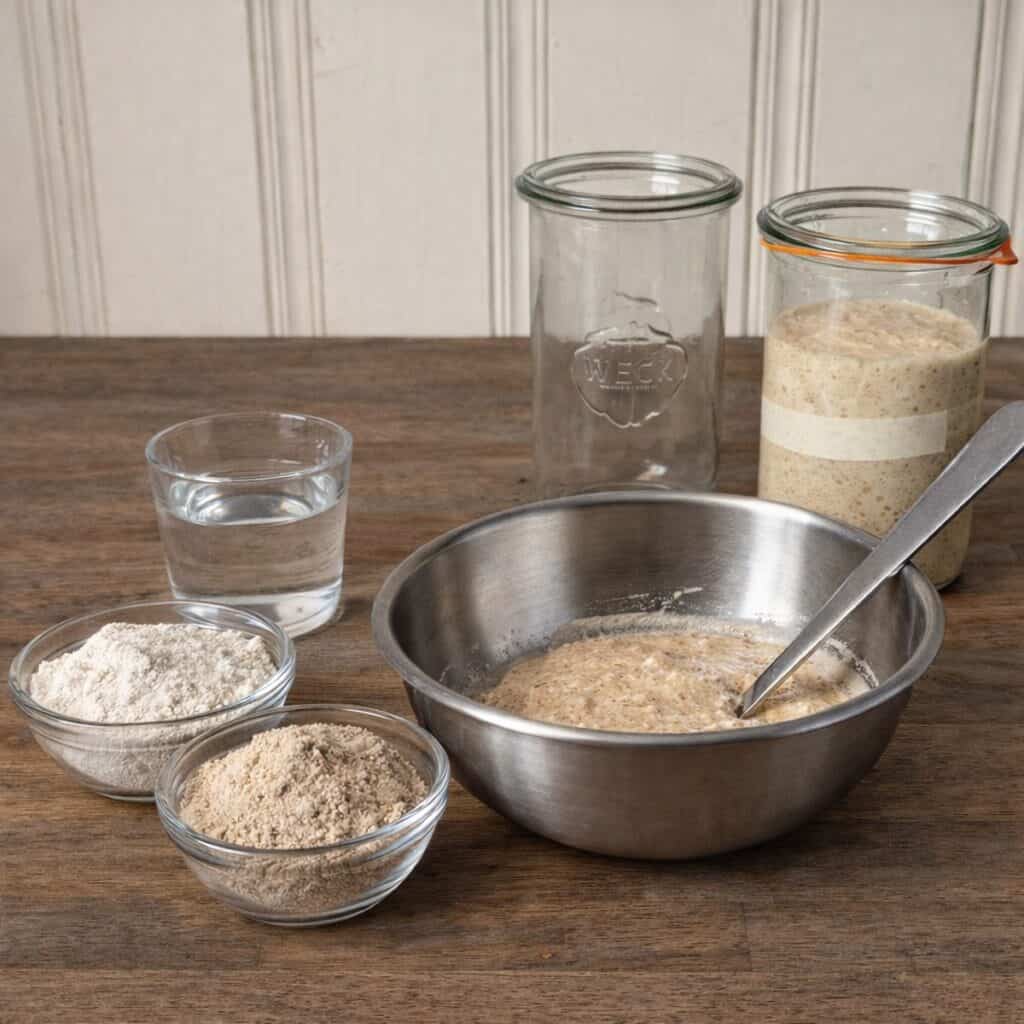
You can build a starter with white flour alone. But a 50/50 blend gets strong faster. Whole wheat keeps the bran and germ, which carry more natural yeast and bacteria, plus minerals and enzymes for the culture to feed on. White flour is mostly starch. Whole wheat brings infrastructure. Whole wheat jump-starts the microbes; bread flour stabilizes the structure. King Arthur or Bob's Red Mill whole wheat are good picks. Whole rye flour is an even faster starter food if you want to swap it in. Whole wheat is not required. It makes the early days more resilient. You will smell it: nutty, almost malty.
Water
Room-temperature water, 70 to 75°F. If your tap water is heavily chlorinated, use filtered water, or leave tap water out overnight before using it. Otherwise, plain tap water is usually fine.
Scale and jar
A digital scale that reads in single grams, like an OXO or Escali kitchen scale. A clean 16 to 32 oz glass jar with straight sides, so you can see the rise and mark it; Weck and Ball jars both work. Rest the lid on top. Do not seal it. A spoon or small spatula and a rubber band or marker finish the kit. Nothing more.
Variations
- All bread flour: Once the starter is stable, you can feed it all bread flour. The culture adapts. Expect a milder, cleaner flavor.
- Rye starter: Swap the whole wheat for whole rye flour. Rye ferments fast and smells earthy and sour, great for rye and darker breads.
- Stiff starter: Feed with half as much water as flour (for example, 50 g starter, 100 g flour, 50 g water). It ferments more slowly and tastes milder, a style common in Italian baking.
- Use the discard: Save discard in a covered jar in the fridge and use it within about a week for pancakes, waffles or crackers.
Make Ahead, Storage and Freezing
Bake often: Keep the starter at room temperature and feed it every 24 hours.
Bake now and then: Keep it in the refrigerator, covered, and feed it once a week. Before baking, give it 1 to 2 room-temperature feedings so it peaks at full strength again. Strong starters are the ones that get fed.
Going away: A well-fed starter can usually sit in the fridge for 2 to 3 weeks. It will look gray and smell sharp. Pour off the liquid and feed it a few times at room temperature; it should bounce back.
Freezing and drying: You can freeze a few spoonfuls of active starter in a small container as a backup. It can take several feedings to wake up, and freezing can weaken it. Drying is often more reliable: spread a thin layer on parchment, let it dry completely, break it into flakes and store them in an airtight jar.
What to Serve with Sourdough Starter
A starter is the beginning, not the meal. Once you have learned to read fermentation, that skill carries straight into bread, long-fermented pizza dough and beyond. Here is where a good loaf belongs:
- Roman Pizza: practice long fermentation with a high-hydration pan dough.
- Pane di San Giuseppe (St. Joseph's Bread): a festive Italian loaf to bake next.
- Ribollita: the Tuscan soup made for day-old country bread.
- New England Clam Chowder: with thick slices of tangy sourdough for dipping.
- Shallot-Caper Compound Butter Board: spread on warm, crusty sourdough.
- Apple French Toast Casserole: a good home for the last of a loaf.
Sourdough Starter FAQ
How long does it take to make a sourdough starter?
Usually 5 to 7 days at 70 to 75°F. In a cooler kitchen, below 68°F, it can take 8 to 10 days.
How do I know when my starter is ready?
It doubles within 4 to 6 hours of feeding at room temperature, has a domed, bubbly top, and smells clean and tangy, not harsh. When it does this reliably, it is ready to leaven bread.
My starter rose once and then stopped. Did I kill it?
No. A big rise around Day 3 or 4 followed by a slowdown is normal. Keep feeding on schedule and keep it warm.
What is the liquid on top of my starter?
That is hooch, a liquid with a little alcohol in it. It means the starter is hungry. Stir it in for more sour flavor or pour it off, then feed.
Why do I have to discard half?
Discarding keeps the acidity in check and the jar a manageable size. Without it, each feeding is too small for the amount of starter, and the culture stays weak.
How do I know if my starter has gone bad?
Fuzzy mold or pink, orange or red streaks mean it is spoiled: throw it out and start again. Sour, cheesy or acetone smells are normal, especially in the first week.
Can I switch to all bread flour later?
Yes. Once the starter is stable, you can feed it all bread flour. The culture adapts.
Commercial yeast gives speed. Wild fermentation gives structure and character. Once you understand peak timing and feeding ratios, sourdough stops being mystical and becomes manageable. You are not chasing bubbles. You are controlling biology.
Sourdough Starter (Bread + Whole Wheat)

Equipment
- Clean jar (16–32 oz)
- Spoon or small spatula
- Rubber band or marker (to track rise)
Ingredients
Ingredients
- 50 g bread flour unbleached
- 50 g whole wheat flour
- 100 g water room temperature, non-chlorinated if possible
Daily Feeding Ingredients (Days 2–7)
- 50 g bread flour
- 50 g whole wheat flour
- 100 g water
Instructions
Day 1: Start the culture
- Mix the starter: In a clean jar, mix 50 g bread flour, 50 g whole wheat flour and 100 g room-temperature water until smooth. Scrape down the sides and cover loosely (lid resting on top, not sealed).
- Rest: Rest 24 hours at room temperature, 70 to 75°F.
Day 2: First feeding
- Discard half: Discard half the starter, leaving about 100 g in the jar.
- Feed: Add 50 g bread flour, 50 g whole wheat flour and 100 g water. Stir until smooth. Cover loosely and rest 24 hours.
Days 3 to 5: Build strength
- Discard and feed daily: Every day, discard half (leaving about 100 g), then feed with 50 g bread flour, 50 g whole wheat flour and 100 g water. Stir well, scrape the sides and cover loosely. Rest 24 hours between feedings.
- Keep going: Expect activity to fluctuate. A big rise around Day 3 or 4 followed by a slowdown is normal. Keep feeding consistently.
Days 5 to 10: Confirm maturity
- Feed until it doubles: Continue daily feeding until the starter doubles within 4 to 6 hours of feeding and shows a clear rise-and-fall pattern.
- Mark and use at peak: Mark the jar with a rubber band after feeding. Use the starter when it is at its peak: domed top, airy texture, lots of bubbles, and doubled in size.
Notes
It should double in 4–6 hours after feeding at room temperature and smell clean and tangy, not harsh. My starter rose once and stopped. Did I kill it?
No. Early blooms are normal. Keep feeding on schedule and control temperature. There’s liquid on top — is that bad?
That’s “hooch” (alcohol). Stir in or pour off, then feed. Should I use filtered water?
If your tap water is heavily chlorinated, filtered water can help. Otherwise, room-temp tap water is usually fine. Can I switch to all bread flour later?
Yes. Once stable, you can feed all bread flour. The culture adapts.
Made this? Leave a star rating and a comment below: what day did your starter first double? I read every comment.

Comments
No Comments