
By Chef Samantha Tilley, executive chef at The Market CT and former chef-owner of Mockingbird Kitchen & Bar.
Southern fried chicken has tangled, deep roots. Scottish immigrants brought a habit of frying chicken in fat. West African cooks brought bold seasoning and frying traditions of their own. In the kitchens of the American South, it was largely enslaved Black cooks who brought those threads together and built the dish most people picture today: seasoned, dredged, and fried in a heavy skillet. After emancipation, Black women in Gordonsville, Virginia, sold fried chicken to train passengers through open windows, turning that skill into a living. Fried chicken was never restaurant food to start. It was a way to stretch a bird, feed a table, and turn time and care into something worth sitting down for.
Southern fried chicken isn't about crunch alone. It's about control. Properly seasoned meat, a coating that stays where it belongs, and oil held at the right temperature from start to finish. Whether you start with buttermilk or a dry rub, the goal is the same: juicy chicken, crisp crust, and nothing greasy left behind. Done correctly, the crust seals in moisture while the oil drives off surface water, leaving the chicken crisp rather than heavy.
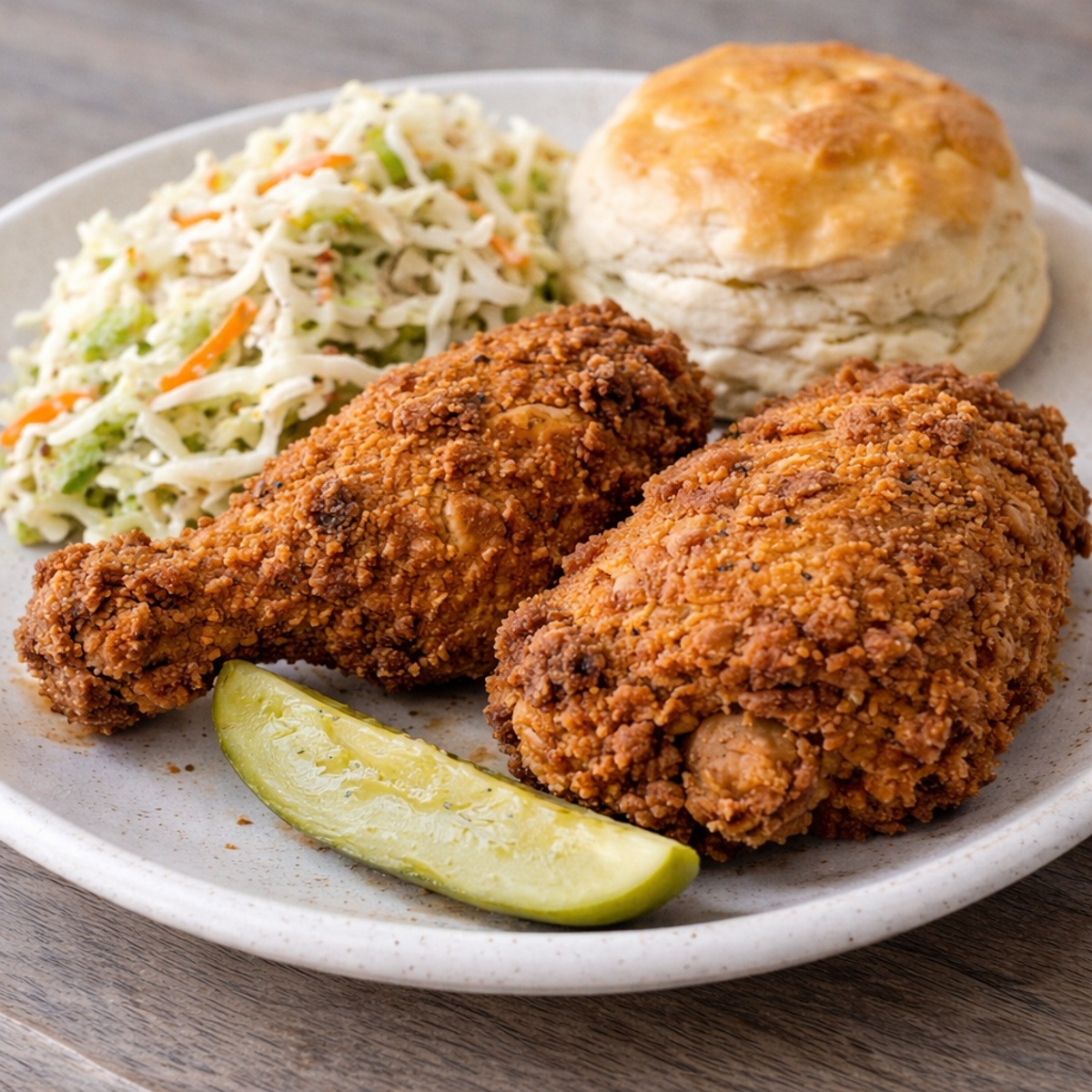
Then the platter hits the middle of the table, still crackling faintly. The crust shatters on the first bite, steam rolls out of the meat, and someone is already reaching for a second thigh. Biscuits, slaw, a jar of pickles. Eat with your hands. This dish is meant to be passed, not plated.
Technique Intelligence
Southern fried chicken is a lesson in moisture management, rest, and heat discipline.
The Double Dredge and the Rest
Dredge. Rest. Dredge again. The rest is where the crust is built. The first dredge isn't about thickness; it's about adhesion. After 20 to 30 minutes on a rack, the flour hydrates and bonds to the surface of the chicken, turning from powdery white to damp and set. A second, lighter dredge after that rest builds the shaggy, craggy texture that crunches loudly when you bite it. Skip the rest or rush the second coat and the crust will either slide off or turn doughy. Some cooks double-dredge without resting, but adhesion and texture suffer.
Oil Temperature
Hold the oil between 325 and 350°F. Watch the thermometer, not the clock. Too hot and the coating sets and darkens before the meat cooks. Too cool and even a good dredge soaks up fat. Cold chicken drops the temperature fast, so fry in batches and let the oil recover between them. Listen: a steady, lively sizzle means you're in the zone; a lazy bubble means the oil has dropped. Dark meat takes 13 to 15 minutes, white meat 10 to 13. Fried chicken rewards patience and punishes shortcuts.
Doneness: Trust the Thermometer
Color tells you about the crust, not the meat. Check the thickest part of each piece, away from the bone, with an instant-read thermometer. The USDA safe temperature for chicken is 165°F. Dark meat is safe there too, but taking thighs and drumsticks to 175°F gives a more tender, less rubbery bite. New to thermometers? Start with this guide to meat thermometers for home cooks. Then rest the chicken 5 minutes on a rack so the juices settle.
The Pan, the Rack and Frying Safety
Use a heavy cast-iron skillet or Dutch oven. Heavy metal holds heat and keeps the oil from swinging every time a piece goes in. Drain on a wire rack. Avoid thin pans and paper towels, which trap steam and soften the crust.
Hot oil deserves respect. Keep the oil about 2 to 3 inches deep and never fill the pot more than halfway. Let excess buttermilk drip off before dredging, and lower each piece in with tongs, laying it away from you. Never leave the pot unattended. Keep a lid or sheet pan nearby to smother a flare-up, and never put water on an oil fire. A splatter screen helps. Let the oil cool completely before straining or discarding it.
What Can Go Wrong
- Crust flakes off: the first dredge wasn't rested long enough.
- Thick, doughy crust: the second dredge was too heavy or the oil was too cool.
- Uneven crunch: weak spots were missed during the second dredge.
- Greasy chicken: the oil temperature dropped or the pan was overcrowded.
- Dark crust, raw center: the oil was too hot. Lower the heat and extend the cooking time.
Ingredient Intelligence
Chicken
Bone-in, skin-on pieces cook evenly and stay moist. The bone moderates heat, giving the crust time to set without drying the meat. A whole 3½ to 4 pound chicken cut into 8 pieces is the classic move. Air-chilled birds, such as Bell & Evans, carry less water and fry up crisper. Prefer dark meat? Use all thighs and drumsticks; they're juicier and more forgiving. Boneless cuts work, but the margin for error is narrower.
Option 1: Buttermilk Marinade
Buttermilk seasons the chicken throughout and gently tenderizes the meat. More importantly, it creates a tacky surface that helps the flour cling. This is the most forgiving method and ideal when time allows. Buy real cultured buttermilk, full-fat if you can find it. In a pinch, stir 1 tablespoon lemon juice or white vinegar into 1 cup milk and let it stand 10 minutes. It's thinner and less tangy, but it works.
Option 2: Dry Rub
A dry rub relies on salt to draw moisture to the surface, forming a natural paste that binds the dredge. It's practical when buttermilk isn't available and produces a slightly firmer, more direct bite. Use Diamond Crystal kosher salt. If you only have Morton kosher salt, which is denser, cut the salt by about a third.
Flour and Spice
All-purpose flour provides structure. The first dredge creates the bond; the second creates texture. Gold Medal all-purpose is a reliable pick; White Lily, the soft Southern flour, gives a slightly more tender, delicate crust. Black pepper brings bite, paprika warmth, and cayenne stays in the background. Taste a pinch of the seasoned flour before you start. It should taste well-seasoned on its own. For gluten-free chicken, Bob's Red Mill Gluten Free 1-to-1 Baking Flour is a good swap.
Frying Fat
Use a neutral oil with a high smoke point. Peanut oil is traditional, and LouAna peanut oil is easy to find. Vegetable or canola oil, such as Crisco, work well too, and they're the right call if anyone at the table has a peanut allergy. Flavor comes from seasoning and technique, not the oil.
Variations
- Nashville-style hot chicken: brush the hot fried chicken with a paste of hot frying oil, cayenne, a little brown sugar and paprika. Serve on white bread with pickles. Nashville's hot chicken is widely credited to the Prince family and their restaurant, Prince's Hot Chicken Shack.
- Hot sauce buttermilk: stir 2 to 3 tablespoons Crystal or Texas Pete hot sauce into the buttermilk for a gentle, vinegary heat.
- Pickle-brine soak: replace about ½ cup of the buttermilk with dill pickle brine for extra tang and seasoning.
- Extra-crisp crust: swap ½ cup of the flour for cornstarch. The crust fries up lighter and crunchier.
- Skillet shallow-fry: skillet frying is traditional for shallow-oil methods but requires frequent turning. Keep the oil about halfway up the pieces.
- Boneless thighs or tenders: they cook much faster. Start checking early and pull them at 165°F.
- Heat level: spice levels vary by household; heat is optional, seasoning is not.
Make Ahead, Storage and Freezing
Make ahead: marinate in buttermilk 4 to 24 hours, or dry-rub and refrigerate uncovered at least 2 hours, preferably overnight. Don't push the buttermilk past 24 hours; the meat turns soft. Mix the seasoned flour up to a week ahead and keep it in a sealed jar.
Storage: fried chicken is best the day it's made but holds well refrigerated up to 2 days. Cool it and get it into the fridge within 2 hours of frying. Cold fried chicken straight from the fridge, with its firm, salty crust, is a pleasure of its own.
Reheating: reheat uncovered on a rack set over a sheet pan in a 400°F oven for about 15 to 20 minutes, until the crust crackles again and the center reaches 165°F. Skip the microwave. It steams the crust soft.
Freezing: wrap cooled pieces tightly and freeze up to 2 months. Thaw overnight in the refrigerator, then reheat in the oven as above. The crust won't be quite as crisp as fresh, but it comes close.
What to Serve with Southern Fried Chicken
Fried chicken belongs at the center of a simple table:
- Buttermilk Biscuits or plain white rice
- Old Fashioned Southern Cornbread, baked in cast iron
- Coleslaw or braised greens for contrast
- Baked Mac and Cheese
- American Potato Salad for a cool, creamy side
- Pickles or hot sauce to keep things moving
To drink, Southern fried chicken needs acidity and refreshment, not weight or tannin. A chilled dry sparkling wine, Prosecco or Crémant, cuts through the fat and resets the palate with every cold, fizzy sip. An unoaked Chardonnay or dry Riesling works well, especially when the seasoning leans peppery. Avoid red wine. Tannin and fried crust rarely get along. Iced tea, sweet or not, is never wrong.
Southern Fried Chicken FAQ
What temperature should the oil be for fried chicken?
Keep the oil between 325 and 350°F the whole time. Use a clip-on or instant-read thermometer, fry in batches, and let the oil come back up to temperature between batches.
How long does it take to fry chicken?
Bone-in dark meat takes about 13 to 15 minutes and bone-in white meat about 10 to 13 minutes at 325 to 350°F. Size varies, so always confirm with a thermometer.
What internal temperature should fried chicken reach?
Chicken is safe at 165°F, measured in the thickest part away from the bone. Many cooks take dark meat to 175°F because it becomes more tender at that temperature.
Why does the breading fall off my fried chicken?
Usually the first dredge didn't rest long enough to bond to the chicken. Rest the coated pieces on a rack for 20 to 30 minutes before the second dredge, don't crowd the pan, and don't move pieces until the crust has set.
Is buttermilk or a dry rub better for fried chicken?
Both work. Buttermilk is the most forgiving and gives a tender, tangy result with a crust that clings well. A dry rub is simpler, needs no dairy, and gives a slightly firmer bite.
What is the best oil for frying chicken?
Peanut oil is traditional. Canola or vegetable oil works just as well and is the safe choice for anyone with a peanut allergy. Any neutral oil with a high smoke point will do.
How do you reheat fried chicken and keep it crispy?
Reheat it uncovered on a rack in a 400°F oven for about 15 to 20 minutes, until it reaches 165°F. Avoid the microwave, which makes the crust soggy.

Southern Fried Chicken (Buttermilk or Dry Rub)

Equipment
- Equipment
- Heavy cast-iron skillet or Dutch oven
- Instant-read or clip-on thermometer
- Tongs or spider strainer
- Optional but Useful
Ingredients
Ingredients
Chicken
- 1 whole chicken 3 ½–4 lb, cut into 8 pieces (or 8 bone-in, skin-on pieces)
- Kosher salt and black pepper
Option A: Buttermilk Marinade
- 2 cups buttermilk
- 1 tablespoon kosher salt
- 1 teaspoon black pepper
- Option B: Dry Rub
- 1 ½ tablespoon kosher salt
- 1 teaspoon black pepper
- 1 teaspoon paprika
- ½ teaspoon garlic powder
- ¼ –½ teaspoon cayenne optional
Seasoned Flour (Dredge)
- 2 ½ cups all-purpose flour
- 2 teaspoon kosher salt
- 2 teaspoon black pepper
- 2 teaspoon paprika
- 1 teaspoon garlic powder
- ½ teaspoon onion powder
- ¼ –½ teaspoon cayenne optional
For Frying
- Neutral oil peanut, canola, or vegetable, for frying (about 2–3 inches deep)
Instructions
Choose your method
- Pick a method: Use the buttermilk method for the most forgiving, classic result. Use the dry-rub method when buttermilk isn't available or when you want a slightly firmer bite.
Method A: Buttermilk (double dredge)
- Season: Season the whole chicken (3½ to 4 pounds, cut into 8 pieces) lightly on all sides with kosher salt and black pepper.
- Marinate: In a large bowl, whisk together 2 cups buttermilk, 1 tablespoon kosher salt and 1 teaspoon black pepper. Add the chicken, cover and refrigerate 4 to 24 hours.
- Mix the seasoned flour: In a wide bowl, mix 2½ cups all-purpose flour, 2 teaspoons kosher salt, 2 teaspoons black pepper, 2 teaspoons paprika, 1 teaspoon garlic powder, ½ teaspoon onion powder and ¼ to ½ teaspoon cayenne, if using.
- Drain: Remove the chicken from the buttermilk, letting the excess drip off.
- First dredge: Coat each piece in the seasoned flour, pressing lightly.
- Rest: Arrange the chicken on a wire rack and rest 20 to 30 minutes, until the coating looks damp and set.
- Second dredge: Lightly coat again, focusing on bare or thin spots. Shake off the excess flour.
- Fry: Heat the neutral oil (about 2 to 3 inches deep) to 325 to 350°F. Fry the chicken in batches, turning as needed, until golden and cooked through: dark meat 13 to 15 minutes, white meat 10 to 13 minutes. Confirm doneness with an instant-read thermometer in the thickest part, away from the bone: 165°F for white meat, 175°F for dark meat.
- Drain and rest: Drain on a rack and rest 5 minutes before serving.
Method B: Dry rub (double dredge)
- Season: Pat the whole chicken (3½ to 4 pounds, cut into 8 pieces) dry. Season all over with 1½ tablespoons kosher salt, 1 teaspoon black pepper, 1 teaspoon paprika, ½ teaspoon garlic powder and ¼ to ½ teaspoon cayenne, if using.
- Refrigerate: Refrigerate uncovered at least 2 hours, preferably overnight.
- Mix the seasoned flour: In a wide bowl, mix 2½ cups all-purpose flour, 2 teaspoons kosher salt, 2 teaspoons black pepper, 2 teaspoons paprika, 1 teaspoon garlic powder, ½ teaspoon onion powder and ¼ to ½ teaspoon cayenne, if using.
- First dredge: Coat the chicken in the flour, pressing lightly.
- Rest: Rest on a wire rack 20 to 30 minutes.
- Second dredge: Lightly coat again, focusing on weak spots.
- Fry: Fry in neutral oil (about 2 to 3 inches deep) at 325 to 350°F until golden and cooked through: dark meat 13 to 15 minutes, white meat 10 to 13 minutes. Confirm doneness with an instant-read thermometer in the thickest part, away from the bone: 165°F for white meat, 175°F for dark meat.
- Drain and rest: Drain on a rack and rest 5 minutes before serving.
Notes
Made this? Leave a star rating and a comment below: are you a buttermilk cook or a dry-rub cook? I read every comment.
Comments
No Comments