
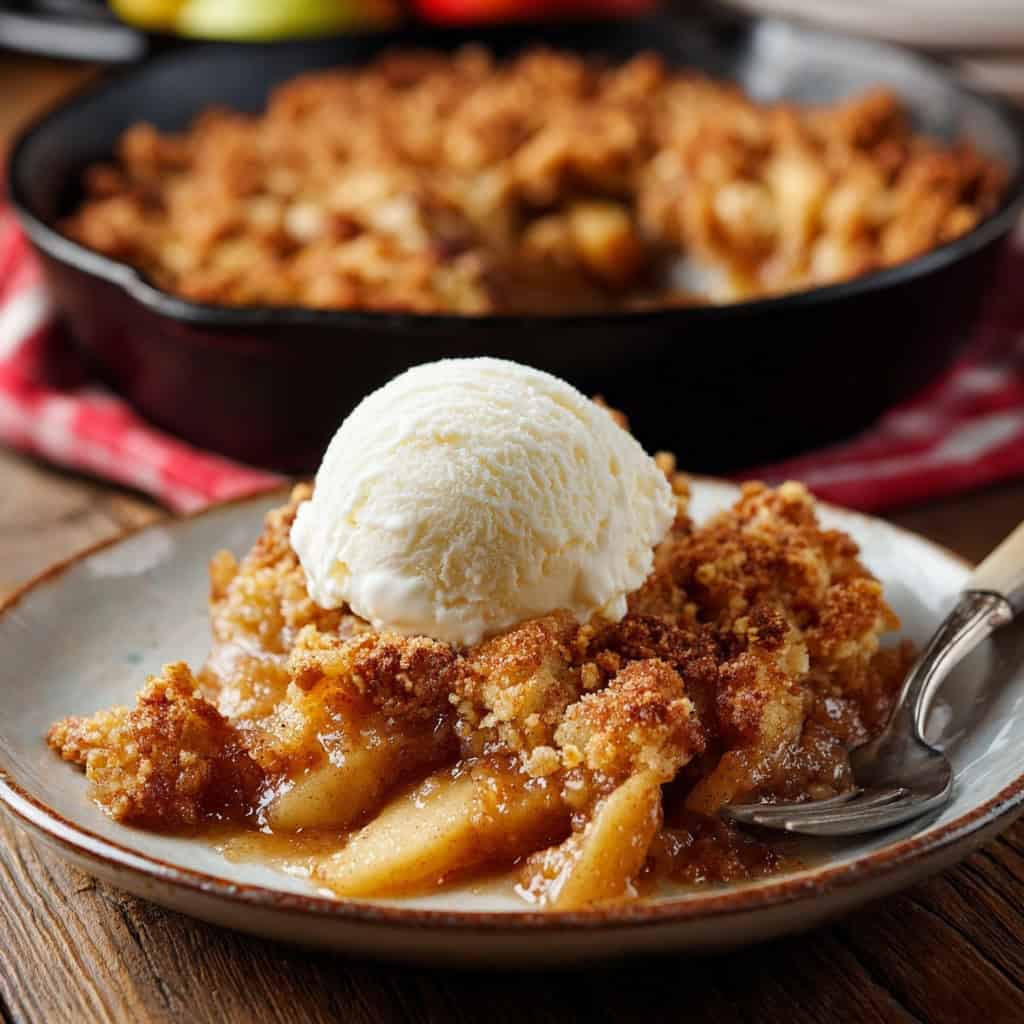
Apple Brown Betty grew out of practical American kitchens long before it became a cookbook dessert. The first printed references appeared in the mid-1800s, although versions likely existed earlier in colonial homes where waste simply was not an option. Rather than rolling pie dough, cooks layered apples with buttered bread crumbs made from day-old bread already sitting in the kitchen. It transformed leftovers into something comforting and useful. That structure also separated Brown Betty from crisps, cobblers, and pies. Instead of fruit underneath with a topping above, Brown Betty builds alternating layers so juices move through the dessert as it bakes, creating soft and crisp textures in the same spoonful.
Apple Brown Betty rewards technique disguised as simplicity. Apples should hold some structure rather than collapsing into sauce. Butter should coat the crumbs evenly because dry patches stay dry and overloaded areas become greasy. Warm spices should support the apples rather than bury them. Like many older recipes, the ingredients are simple enough that technique quietly becomes the most important ingredient.
There is something about warm baked apples and butter that changes the room before dessert ever reaches the table. People suddenly become curious about what is in the oven. Spoons appear before plates do. Vanilla ice cream begins melting into the corners while someone insists they only want a small portion before returning for more. Some desserts feel formal. Apple Brown Betty has always felt more like home.
Technique Intelligence
Choose apples that hold their structure
Apples behave differently during baking because of their moisture content and cell structure. Firmer apples such as Honeycrisp, Granny Smith, Braeburn, and Pink Lady maintain texture while softer apples tend to break down more quickly. Combining a sweet apple with a tart apple often creates better flavor and texture balance.
Build layers instead of a topping
Unlike crisps or cobblers, Apple Brown Betty depends on repeated layers of apples and buttered crumbs. As the apples release juices during baking, some crumbs soften while others toast, creating the texture that defines the dessert.
Coat the crumbs evenly
Butter should lightly coat the bread crumbs rather than saturate them. Even coating creates uniform browning and texture throughout the dessert while preventing dry patches or greasy sections.
Rest before serving
Fresh from the oven, the juices remain loose and active. Allowing the dessert to rest for 10–15 minutes gives starches and sugars time to settle so the filling thickens slightly before serving.
Ingredient Intelligence
Apples
Apples become the center of the dessert, so variety matters. Firmer apples maintain structure while softer varieties break down faster during baking. Combining tart and sweet apples often creates a more balanced result.
I usually combine Honeycrisp Apple with Granny Smith Apple or Braeburn Apple.
Bread Crumbs
Traditional Apple Brown Betty uses bread crumbs rather than streusel. Day-old bread creates toasted buttery layers and gives the dessert its recognizable texture. Brioche creates a richer version while sandwich bread produces a lighter, more traditional texture.
Brown Sugar
Brown sugar contributes sweetness while molasses adds warmth and depth that naturally supports apples and spices.
I often use Domino or C&H.
Cinnamon
Cinnamon supports apple flavor rather than replacing it. Warm spice should sit in the background and make the fruit taste more like itself.
I usually keep Simply Organic or McCormick nearby.
What to Serve with Apple Brown Betty
- Vanilla ice cream
- Fresh whipped cream
- Salted caramel sauce
- Hot coffee
- Chai tea
- Sharp cheddar cheese
Apple Brown Betty

Equipment
- 9 x 13 baking dish or 2-quart casserole dish
- Large mixing bowl
- Medium mixing bowl
- Chef knife or apple peeler/corer
- Measuring cups and spoons
- Rubber spatula or wooden spoon
- Sauté pan (for buttering bread crumbs)
- Aluminum foil (optional)
Ingredients
Apple Filling
- 6 medium apples Honeycrisp, Granny Smith, Braeburn, or combination
- ⅓ cup granulated sugar
- ¼ cup brown sugar
- 1 tablespoon lemon juice
- 1½ teaspoons cinnamon
- ¼ teaspoon nutmeg
- ¼ teaspoon kosher salt
Buttered Bread Crumbs
- 4 cups fresh bread crumbs or coarse day-old bread crumbs
- 8 tablespoons unsalted butter melted
- ½ cup brown sugar
- 1 teaspoon cinnamon
Optional for Serving
- Vanilla ice cream
- Fresh whipped cream
- Salted caramel sauce
Instructions
- Preheat oven to 350°F and lightly butter a 9 x 13 baking dish.
- Peel, core, and slice 6 apples into approximately ¼-inch slices.
- In a large bowl combine apples, ⅓ cup granulated sugar, ¼ cup brown sugar, 1 tablespoon lemon juice, 1½ teaspoons cinnamon, ¼ teaspoon nutmeg, and ¼ teaspoon kosher salt. Toss evenly.
- In a separate bowl combine 4 cups bread crumbs, 8 tablespoons melted butter, ½ cup brown sugar, and 1 teaspoon cinnamon. Mix until crumbs are evenly coated.
- Spread a thin layer of crumb mixture into the baking dish.
- Add a layer of apples.
- Repeat layers of crumbs and apples until ingredients are used, finishing with a final crumb layer.
- Cover loosely with foil and bake for 30 minutes.
- Remove foil and continue baking for 15–20 minutes, until apples are tender and the top becomes golden brown.
- Rest 10–15 minutes before serving.
- Serve warm with vanilla ice cream or whipped cream.
Notes
Combining sweet and tart apples creates better flavor and texture balance.
Day-old bread gives more texture than packaged fine crumbs.
Brioche creates a richer Brown Betty while sandwich bread creates a more traditional version.
The dessert thickens slightly as it rests.

Comments
No Comments