
Ribs at a Glance
Rib types: Baby Back • Spare Ribs • St. Louis Style • Beef Back Ribs • Short Ribs • Country Style Ribs
Smoke, time, fat, collagen, and patience all meet here. Good ribs are not about cooking meat until it falls apart. Great ribs live in the space between resistance and tenderness — where the meat gives way with a bite but still remembers it once had structure.
What Are Ribs?
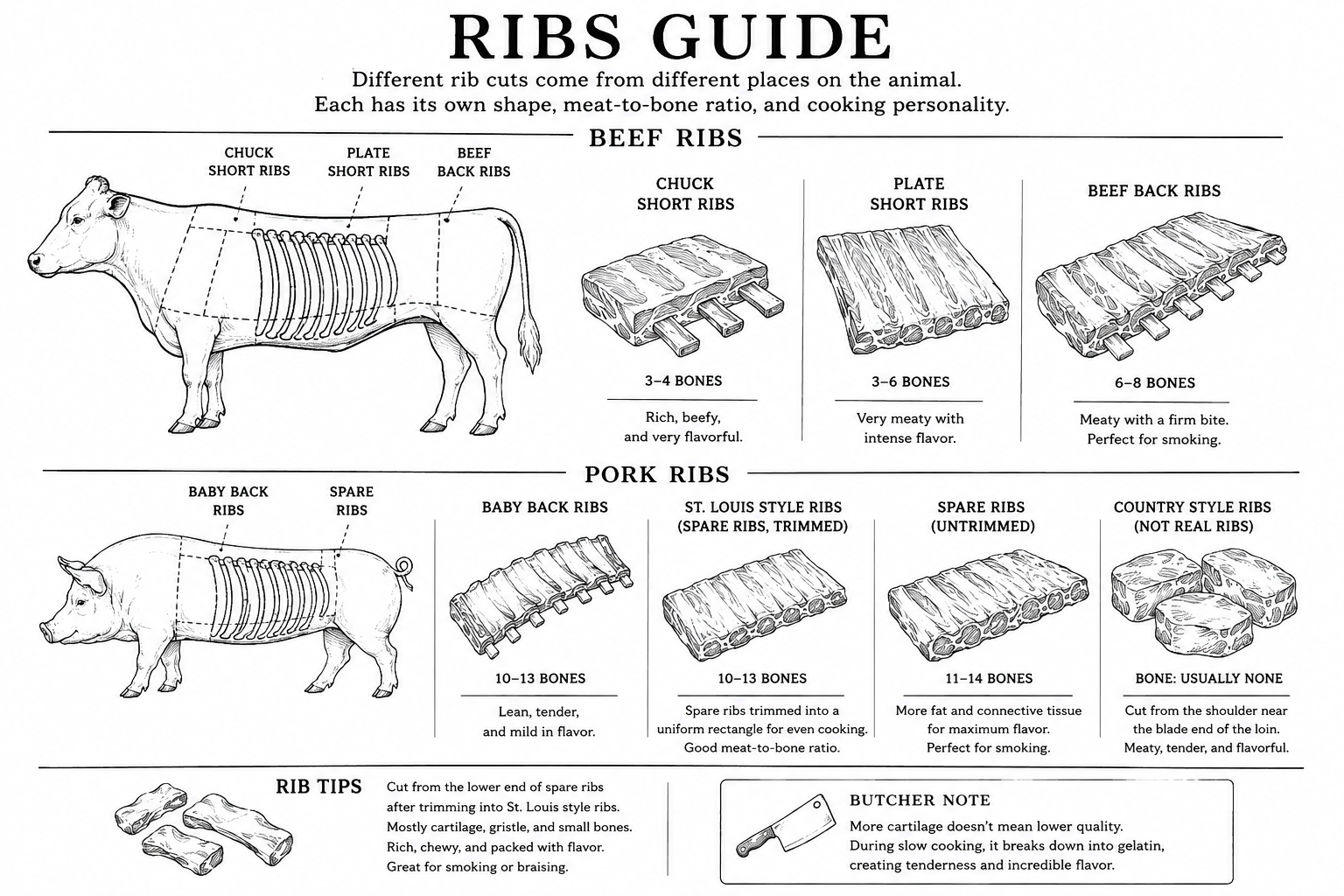
Ribs are cuts taken from the rib cage where meat, fat, connective tissue, and bone meet. Different rib cuts contain different ratios of each, which is why they behave differently during cooking.
Pork: Baby backs tend to be leaner and cook more quickly. Spare ribs contain more fat and connective tissue, creating deeper flavor and richer texture. St. Louis ribs are simply spare ribs trimmed into a more uniform shape for even cooking. Country Style ribs are cut from the shoulder neat the blade.
Beef: Beef back ribs come from the upper rib section after ribeye or prime rib is removed and contain meat between the bones with a traditional rib structure. Plate short ribs, often called dinosaur ribs in barbecue, come from the lower plate beneath the ribeye and contain thick layers of heavily marbled meat above the bone. Chuck short ribs come from the shoulder area and contain substantial connective tissue that slowly converts into gelatin during cooking. Flanken short ribs are cut across the bones rather than between them, creating thinner cross-cut pieces commonly used in Korean barbecue and faster cooking preparations. Beef ribs generally respond best to smoking, braising, and slow roasting, where controlled heat has time to render fat and break down connective tissue.
The important thing to understand is that ribs are not naturally tender. They become tender because heat slowly converts collagen into gelatin.
Technique Intelligence
Ribs teach one of the most important lessons in cooking:
Low temperatures plus time transform tough cuts.
High heat tightens muscle fibers before connective tissue has time to break down. Low and controlled cooking gives collagen time to melt while protecting moisture.
You are managing three things simultaneously:
- Fat rendering — melting and distributing flavor
- Collagen conversion — turning connective tissue into gelatin
- Surface development — building bark, crust, and smoke flavor
People often chase "fall off the bone" ribs because restaurants trained them to think that means quality. It usually means overcooked.
Competition barbecue judges and experienced pitmasters often look for what they call a clean bite — where the meat pulls away easily but leaves a defined bite mark.
Cooking Types
Low & Slow Smoking
This is the classic barbecue approach. Ribs cook with indirect heat over several hours while smoke gradually develops flavor and collagen slowly converts into gelatin. The goal is controlled rendering rather than aggressive heat.
Best for: Baby backs • Spare ribs • St. Louis ribs • Beef back ribs • Short ribs
Typical temperature: 225–275°F
What you're building: Bark • smoke flavor • rendered fat • tender texture
Indirect Grilling
Indirect grilling turns a standard grill into a small oven. Heat sits on one side while ribs cook on the opposite side with the lid closed.
This gives more control than direct grilling and reduces burning.
Best for: Baby backs • St. Louis ribs • Smaller rib cuts
Typical temperature: 250–325°F
What you're building: Roasted flavor with mild smoke notes
Oven Roasting
The oven is essentially controlled dry heat without smoke. This method is predictable and excellent for learning rib fundamentals because temperature fluctuations are minimal.
Best for: Baby backs • Spare ribs • Country-style ribs
Typical temperature: 275–325°F
What you're building: Tenderness and controlled browning
Braising
Braising combines dry and moist heat. Ribs are first browned and then slowly cooked in liquid until connective tissue breaks down.
Best for: Beef short ribs • Country-style ribs • Rib tips
Typical temperature: 300–325°F oven
What you're building: Rich sauces • deep tenderness • gelatin development
Live Fire Cooking
Ribs cook near wood or charcoal embers using radiant heat and flame management. This method requires the most attention because the fire constantly changes.
Best for: Argentine-style beef ribs • thinner rib cuts
Typical temperature: Variable
What you're building: Char • smoke • fire-driven flavor
Equipment Intelligence
Pellet Grill
Uses compressed wood pellets with electronic temperature control.
Strengths: Easy temperature control • beginner friendly • long cooks become almost hands-off
Watch for: Lighter smoke flavor than traditional wood or charcoal
Offset Smoker
A separate firebox pushes smoke across the cooking chamber.
Strengths: Deep smoke flavor • traditional barbecue results
Watch for: Requires active fire management
Vertical Smoker / Traditional Smoker
Uses a dedicated chamber where heat and smoke circulate around food during long low-temperature cooking.
Strengths: Excellent smoke development • designed specifically for low-and-slow cooking • larger cooking capacity
Watch for: Heat can vary between cooking zones and fuel management may still be required
Charcoal Grill
Can create both direct and indirect cooking zones.
Strengths: Affordable • versatile • stronger smoke flavor than gas
Watch for: Temperature swings if airflow isn't managed
Gas Grill
Convenient and predictable.
Strengths: Fast setup • easy heat adjustment
Watch for: Less smoke flavor unless smoke boxes are added
Santa Maria Grill
Uses an adjustable grate positioned above wood or charcoal embers.
Strengths: Excellent live-fire control • adjustable cooking height • develops smoke and char simultaneously
Watch for: Requires active fire management and heat changes throughout cooking
Dutch Oven
Heavy cast iron with excellent heat retention.
Strengths: Ideal for braising short ribs • excellent heat retention • develops rich sauces
Watch for: Moisture buildup can reduce bark formation
Probe Thermometer
Monitors internal temperature during cooking.
Strengths: Removes guesswork • tracks long cooks • improves consistency
Watch for: Temperature indicates progress, but tenderness determines when ribs are done.
Variations Around the World
- American barbecue approaches ribs regionally through smoke, rubs, and sauces.
- Chinese ribs often lean toward soy, five spice, and sweetness.
- Korean preparations introduce sesame, garlic, pear, and fermented ingredients.
- Caribbean versions frequently move toward allspice, peppers, and jerk influence.
- Argentina often keeps seasoning simple and lets live-fire cooking lead.
How to Enjoy
Ribs rarely arrive alone. Rich cuts need contrast.
Sharp slaws, pickled vegetables, grilled corn, potato salads, beans, vinegary sauces, and lighter herb-driven sides balance the richness.
Storage
Cooked ribs generally reheat best gently and covered to avoid drying out. High reheating temperatures tend to tighten the meat and undo the tenderness you spent hours creating.